You want to be helpful, proactive, and easy to work with. But you also don’t want to come across as pushy, controlling, or like you’re trying to do your manager’s job.
That’s the tricky part of learning how to manage up without overstepping.
Done well, managing up helps you build a stronger working relationship with your boss, clarify expectations, and reduce confusion. When managing up done poorly, it can feel like you’re challenging authority, asking for special treatment, or trying to run the show.
The difference usually comes down to tone, timing, and intent.
What Does It Mean To Manage Up?
Managing up means working intentionally with your manager so you can both be more successful.
It is not about controlling your boss, making them like you, or going around them to get what you want.
At its best, managing up is about making the working relationship clearer, easier, and more productive.
You do this by understanding your manager’s priorities, communicating early, asking good questions, sharing useful updates, and bringing solutions when you raise problems.
In other words, you help your manager manage you well.
That may sound simple, but it matters. Gallup has found that managers account for 70% of the variance in team engagement. So, the relationship you have with your manager can shape your work experience in a big way.
You may not control your manager’s habits. But you can influence the quality of the relationship.
Managing up is not:
- Telling your manager how to do their job
- Correcting them in front of others to prove a point
- Pushing your priorities ahead of the team’s priorities
- Going around your manager when you don’t get the answer you want
- Giving feedback without care, context, or respect
- Acting like you know more than everyone else
- Treating your manager like a problem to fix
That last one is important.
Your manager may be busy, unclear, disorganized, unavailable, or hard to read. That can be frustrating. But managing up works best when you approach the relationship with maturity, not resentment.
You are not taking over.
You are taking responsibility for your side of the relationship.
Why Employees Should Learn To Manage Up Without Overstepping
Most employees spend a lot of time thinking about how their manager communicates with them.
That makes sense. Your manager sets expectations, assigns work, gives feedback, approves decisions, and often shapes your growth opportunities.
But communication should not only flow downward.
Upward communication can feel nerve-wracking, but it becomes easier when you know your audience, choose your timing wisely, stay respectful and honest, and use the right channel.
When you manage up well, you can:
- Reduce misunderstandings
- Clarify priorities
- Get feedback earlier
- Avoid last-minute surprises
- Build trust with your manager
- Show ownership of your work
- Ask for support before a problem grows
- Create more space for honest conversations
It also helps your manager.
Many managers are dealing with competing priorities, senior leader requests, team issues, deadlines, and decisions they cannot always explain fully. When you communicate clearly and bring useful context, you make it easier for them to lead.
That does not mean you absorb your manager’s stress.
It means you become easier to lead because you communicate like a professional.
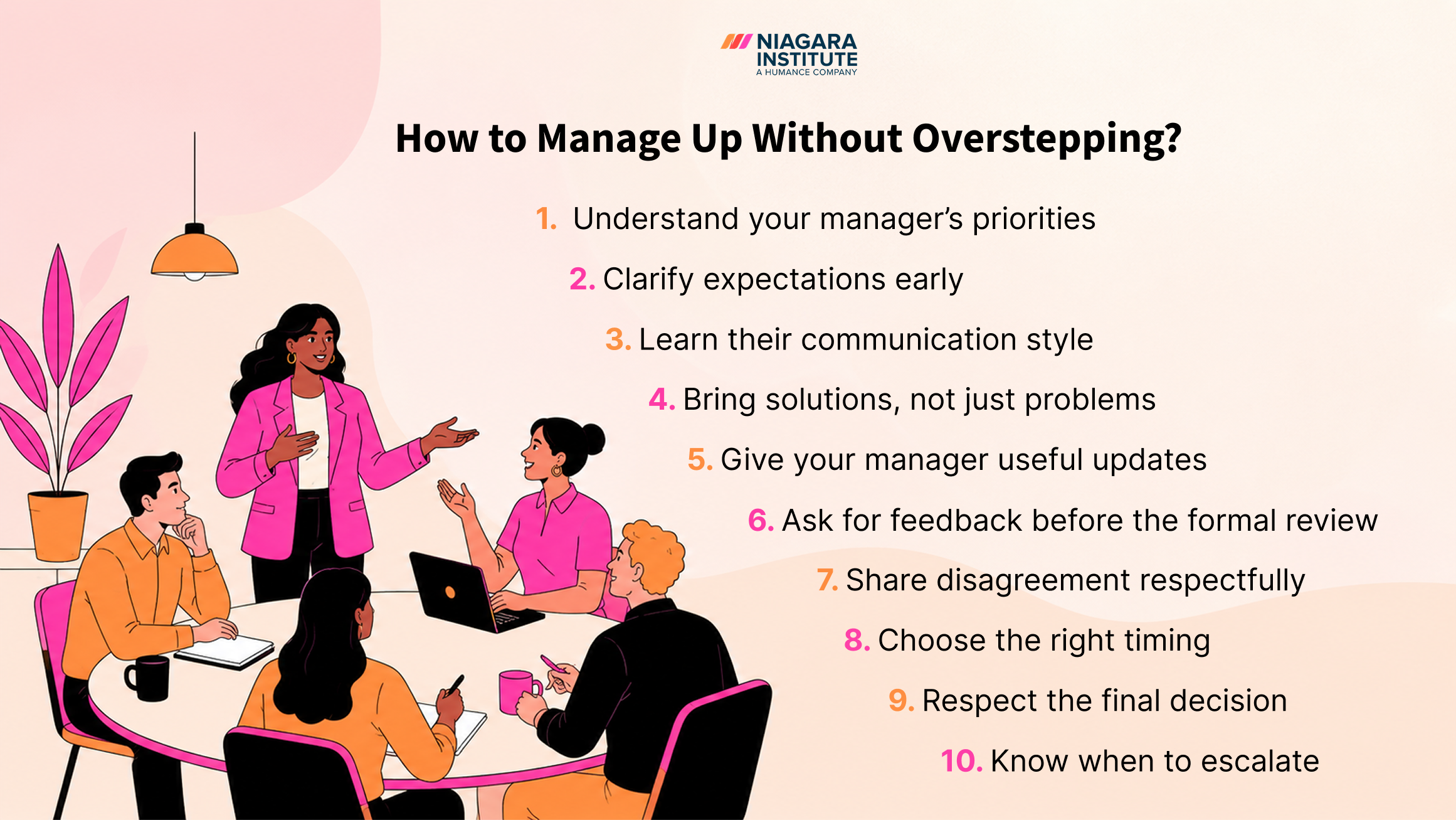
How To Manage Up Without Overstepping
Managing up is a skill. Like any skill, it gets better with practice.
Here are practical ways to do it well.
1. Understand Your Manager’s Priorities
Start by learning what your manager is responsible for.
What goals are they being measured against? What pressures are they managing? What deadlines matter most? What keeps coming up in team meetings, leadership updates, or one-on-ones?
You don’t need to know everything happening above you. But you do need enough context to understand what matters.
You can ask:
- “What are the top priorities you want me focused on this month?”
- “Where does this project fit compared to the other work on the team?”
- “What would make this successful from your point of view?”
- “Is there anything senior leadership is watching closely here?”
This helps you align your work with what your manager actually needs.
Alignment is not the same as blind agreement. It simply means you understand the bigger picture before you act.
2. Clarify Expectations Early
Many workplace issues start with unclear expectations.
You thought the work was due Friday. Your manager expected it Wednesday. You thought they wanted a detailed direct report. They only wanted a short summary. You thought you had full ownership. They expected to review each step.
That is not always a performance problem.
Sometimes it is a clarity problem.
Before you start important work, ask:
- “What does a good final version look like?”
- “When do you want to review this?”
- “How much detail do you want?”
- “Do you want updates along the way or only when it’s complete?”
- “Are there any constraints I should know about?”
These questions show ownership. They also prevent avoidable frustration later.
3. Learn Their Communication Style
Some managers like quick written updates. Others prefer a conversation. Some want details. Others want the headline first and the details only if they ask.
Pay attention.
If your manager likes concise updates, don’t send five long paragraphs when three bullets would do. If your manager likes context, don’t drop a decision in Slack with no explanation.
Niagara Institute’s global workplace communication survey found that 75.3% of respondents use an assertive communication style, while 10.5% use passive, 9.6% use passive-aggressive, and 4.6% use aggressive. That means most people may aim to communicate directly, but the way that directness shows up can still vary a lot.
The better you understand your manager’s style, the easier it is to communicate in a way they can hear and act on.
4. Bring Solutions, Not Just Problems
There will be times when you need to raise a problem. That is part of working well.
The key is to bring the issue with context, options, or a recommendation when you can.
Instead of saying:
- “This isn’t working.”
- “We have a problem.”
- “I don’t know what to do.”
- “The timeline is impossible.”
Try:
- “The timeline is at risk because we’re missing client feedback. I see two options.”
- “I’m blocked on the data from finance. I can either follow up today or adjust the report to use last month’s numbers.”
- “I’m concerned this approach may create confusion for customers. Could we review the message before it goes out?”
- “I don’t think we can meet Friday without cutting scope. Here’s what I recommend we move to next week.”
5. Give Your Manager Useful Updates
Your manager should not have to chase you for basic information.
A useful update tells them what they need to know without making them dig.
A simple format works well:
- What’s done
- What’s in progress
- What’s blocked
- What decision or support you need
- What’s next
For example:
“Quick update: The first draft is done, and I’m waiting on legal review. The only blocker is the client quote, which I should have by Thursday. If it doesn’t come in, I recommend we publish without it and add it later.”
That is short, clear, and helpful and leaves no room for guesswork.
6. Ask for Feedback Before the Formal Review
If you wait until a performance review to learn how your manager sees your work, you are waiting too long.
Ask for feedback in smaller, regular moments.
You can say:
- “Is this the level of detail you were looking for?”
- “What would make the next version stronger?”
- “Is there anything you want me to adjust in how I’m handling this project?”
- “What should I keep doing, and what should I change?”
- “Am I focused on the right priorities?”
Informal feedback that's given in the moment can help correct mistakes quickly and support better ways of working.
That applies upward communication too: when you ask for feedback early, you give yourself more room to adjust.
7. Share Disagreement Respectfully
Managing up does not mean agreeing with everything your manager says.
Sometimes you will see a risk they missed. Sometimes you will have more context from the work itself. Sometimes a decision will affect the team in a way your manager may not realize.
You can disagree without overstepping.
The key is to frame your concern around the work, not your manager’s character.
Try:
- “Can I share a concern I see with that approach?”
- “I may be missing context, but here’s the risk I’m seeing.”
- “From the customer side, I think this could create confusion.”
- “I understand the direction. My concern is the timeline.”
- “Would you be open to another option?”
Assertive communication helps build trust, minimize conflict, manage expectations, and protect boundaries.
That is exactly the tone you need when managing up.
Clear, not combative.
8. Choose the Right Timing
Timing can change how your message lands.
A good point raised at the wrong time may not get the response it deserves. If your manager is rushing into another meeting, handling an urgent issue, or visibly frustrated, that may not be the best moment for a sensitive conversation.
For example:
- “I have a concern about the rollout plan. Is today or tomorrow better to talk it through?”
- “This isn’t urgent, but I’d like 15 minutes this week to get your guidance.”
- “I know now may not be the right time, but I want to flag something before the decision is final.”
- “Could we add this to our next one-on-one?”
Choosing the right timing is not about avoiding the conversation but giving the conversation a better chance.
9. Respect the Final Decision
Sometimes you will manage up well, share your concern clearly, and your manager will still choose a different path.
That can be frustrating.
But once a decision is made, your role is to move forward professionally unless the decision is unethical, unsafe, or seriously harmful.
You can say:
- “I understand. I’ll move forward with that direction.”
- “Thanks for hearing me out. I’ll adjust the plan.”
- “I still see the risk, but I understand the decision. I’ll support the next step.”
- “Can we agree on what we’ll watch for in case we need to adjust?”
10. Know When To Escalate
Managing up does not mean keeping everything between you and your manager forever.
There are times when escalation may be appropriate, especially if there is harassment, discrimination, retaliation, fraud, safety risk, serious ethical concern, or repeated behaviour that harms your ability to work.
In those cases, follow your organization’s process. That may mean speaking with HR, another leader, an ethics line, or a trusted internal contact.
The goal is not to go around your manager because you are annoyed but use the right process when the issue is bigger than a normal working disagreement.
What To Say When Managing Up
Sometimes the hardest part is finding the words.
Here are simple scripts you can adapt.
When You Need Clearer Priorities
“I want to make sure I’m focused on the right work. Of these three priorities, which one matters most this week?”
When You Need Support
“I’m making progress, but I’m blocked by one issue. I’ve tried X and Y. Could I get your guidance on the next step?”
When You See a Risk
“I want to flag a risk before we move too far. If we use this timeline, we may not have enough time for review. Would you be open to adjusting the deadline or reducing scope?”
When You Disagree
“I understand why we’re considering that option. My concern is that it may create more work for the support team. Can I walk you through what I’m seeing?”
When You Need Feedback
“I’d like to know how I’m doing on this project before it’s complete. Is there anything you want me to change now?”
When You Need a Decision
“To keep this moving, I need a decision on A or B by Thursday. My recommendation is A because it gives us more time to test.”
When You Want To Improve the Working Relationship
“I’d like to work more effectively with you. What’s the best way for me to keep you updated, and what should I bring to you earlier?”
You do not need perfect words.
You need respectful, useful words.
Signs You May Be Overstepping at Work
Even with good intentions, managing up can go too far.
Here are signs you may be crossing the line.
1. You Correct Your Manager Publicly Too Often
There may be times when you need to clarify something in a meeting. But if you often correct, challenge, or redirect your manager in front of others, it can start to look like a power struggle.
When possible, save sensitive feedback for a private conversation.
Public clarity is helpful. Public embarrassment is not.
2. You Bring Opinions Without Context
It is fine to have a view. It is better to support that view with facts, examples, and impact.
Instead of saying, “I don’t like this idea,” explain what you are seeing.
For example:
“I’m concerned this may delay the launch because design still needs three days for revisions.”
That gives your manager something useful to consider.
3. You Push After the Decision Has Been Made
There is a difference between raising a concern and refusing to move on.
If your manager heard your point, made a decision, and the issue is not unethical or harmful, continuing to push may damage trust.
You can disagree and still be professional.
4. You Try To Manage Your Manager’s Personality
You can manage communication, expectations, priorities, and working habits.
You cannot manage your manager into becoming a different person.
Focus on what affects the work. That gives you a better chance of making progress.
5. You Skip Your Manager Too Quickly
Going above your manager may be necessary in serious situations. But if you do it every time you disagree, it can look like you are avoiding the relationship instead of working through it.
Start with direct communication when it is safe and appropriate.
Escalate when the issue truly calls for it.
6. You Make Every Conversation About Your Needs
Managing up should help both you and your manager work better.
If every conversation is about your preferences, your frustration, your timeline, or your growth, it can feel one-sided.
Balance your needs with the team’s goals and your manager’s priorities.
That is what makes it professional.
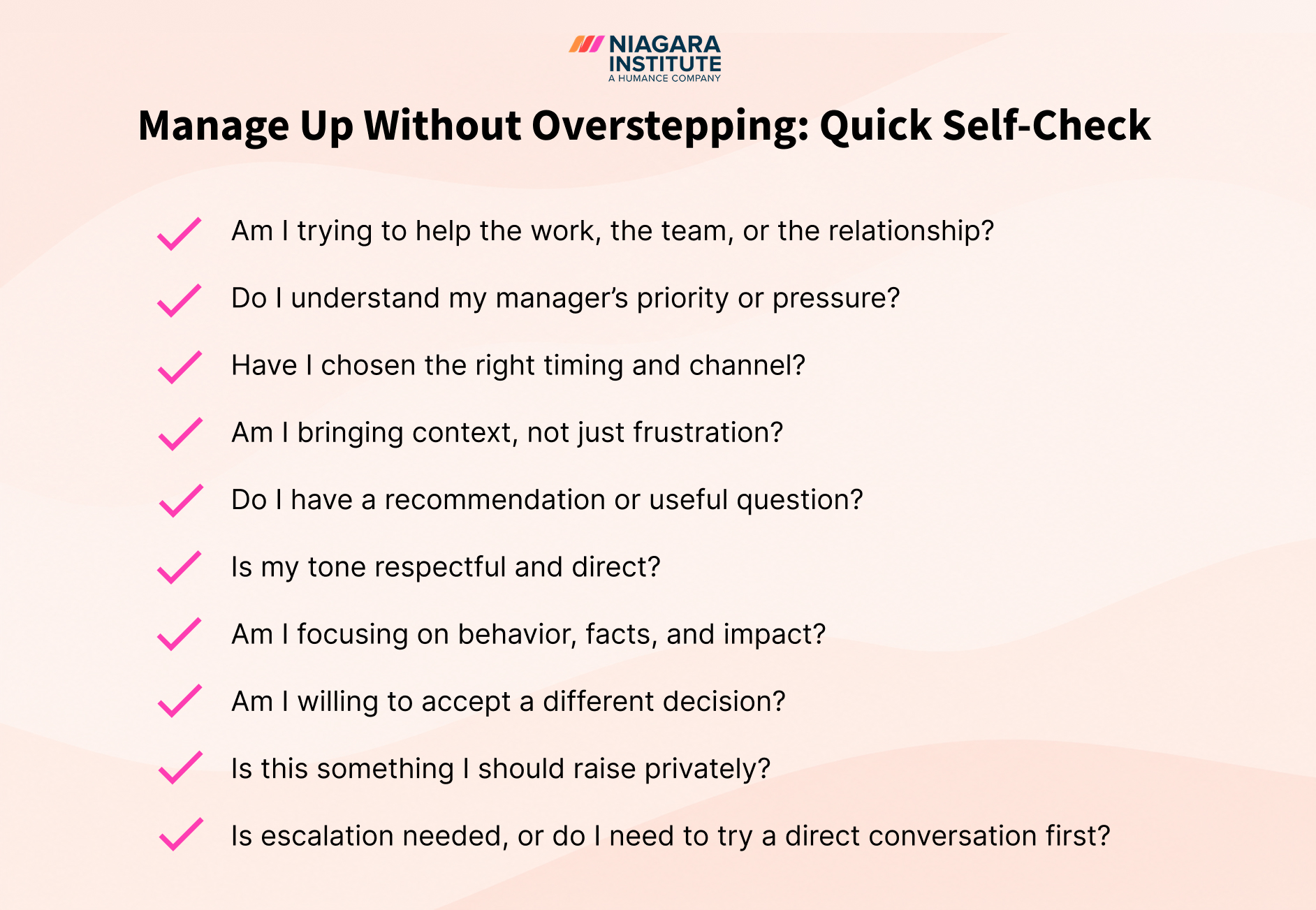
Next Steps
Managing up without overstepping is about being proactive, clear, and respectful. You are not trying to control your manager. You are trying to create a better working relationship so expectations, decisions, and communication are easier for both of you.
Your next step is to pick one area where you need more clarity. Ask your manager a simple, useful question in your next one-on-one, such as, “What should I prioritize this week?” or “What would make this work stronger?”
Start there.
Small, steady communication habits can change the entire relationship.

 Gavin Brown



 Michelle Bennett : Jul 19, 2022, 5:00:00 AM
.png)