Most people use these words like they mean the same thing.
They don't.
You've probably worked for both — a manager who ran a tight ship but left you feeling like a cog in a machine, and someone (maybe not even your boss) who made you want to do your best work. The difference between those two experiences wasn't a job title. It was something harder to name but immediately recognizable when you feel it.
Peter Drucker said it best: "Management is doing things right; leadership is doing the right things."
A manager asks: are we executing well?
A leader asks: are we building toward something worth executing for?
Both questions matter. But they're not the same question and the people who are good at answering one aren't always good at answering the other.
That's the manager-leader gap. And understanding it might be the most useful thing you can do for your career when you transition from individual contributor to a people manager.
What Managers Actually Do?
A manager's job is to make things work reliably and repeatedly.
That means dividing complex projects into clear tasks, making sure the right people are working on the right things, tracking progress, and solving problems before they become crises. A good manager is the reason a team of ten people can function without chaos. They're the person who notices when a deadline is slipping, when a process is breaking down, or when two people on the team are working at cross-purposes.
Managers tend to be practical and structured. They measure success through results: Did we hit the number? Did we ship on time? Did we stay within budget?
This isn't a criticism and organizations genuinely need this. Without someone owning the mechanics of execution, even the best ideas go nowhere.
The challenge is when the role stops there.
What Leaders Actually Do?
Leadership isn't a job description. It's a quality and it shows up in the way someone makes people feel about their work.
A leader gives people a reason to care. They communicate where things are going in a way that makes the destination feel worth reaching. People in leadership positions see potential in people that those people don't always see in themselves. And they build the kind of trust that makes a team willing to take on hard things, because they believe someone in the room has their back.
Here's what makes this interesting: leadership isn't about formal authority. Erin Brockovich wasn't a lawyer or a manager. She was a file clerk. But she saw something that mattered, she believed it deeply, and she brought 600 people along with her to take on a corporation. Her boss had the title. She was the influencer at work.
That's the distinction in its sharpest form. Managers have subordinates. Leaders have people who choose to follow them.
Seven Places Where the Difference Between Manager and Leader Shows Up
In practice, the gap between managing and leading shows up in small, daily choices. Here's where it's most visible.
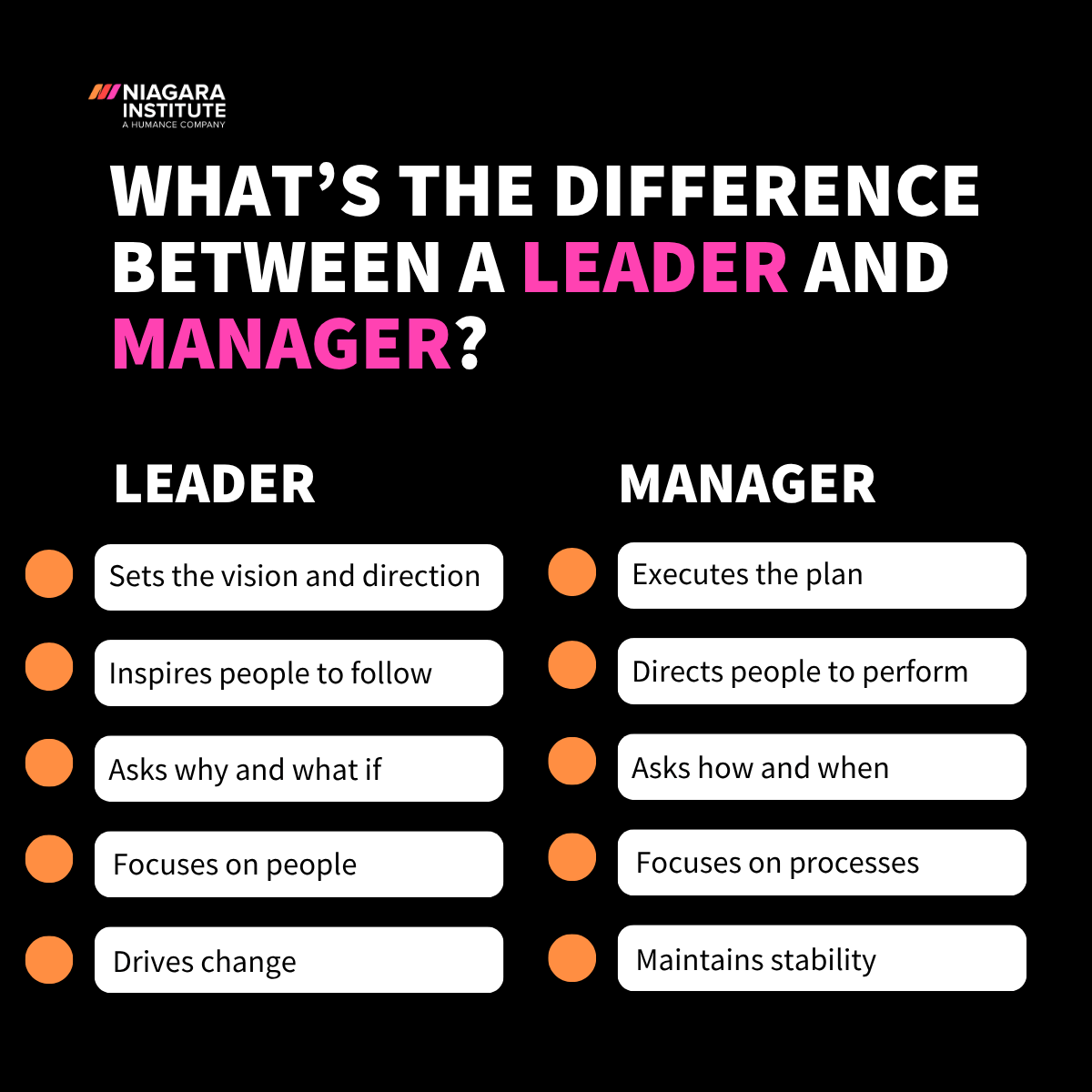
Goals vs. vision. Managers focus on what needs to happen this quarter. Leaders explain why it matters and where it fits in a larger story. Both are necessary. One without the other is either directionless or motivationless.
Authority vs. influence. Managers can tell people what to do. Leaders make people want to do it. The first depends on position. The second depends on trust with employees which is earned slowly and lost fast.
Stability vs. risk. A manager's job is largely to reduce uncertainty and keep the wheels turning. A leader's job sometimes requires introducing uncertainty and challenging what's working, betting on something new, or pushing the organization toward a harder but better path.
Short-term vs. long-term. Managers are looking at this week's priorities and this quarter's numbers. Leaders are looking at where the organization needs to be in three years and working backwards. Both perspectives are essential; the problem is when only one exists.
Control vs. empowerment. Managers maintain oversight of how work gets done. Leaders hand people the keys with the genuine belief that people do better work when they own it and take responsibility.
Problem-solving vs. opportunity-spotting. A manager sees a problem and fixes it. A leader sees a problem and also asks: what does this tell us about where we're headed? What could we be doing differently?
Directing vs. coaching. Managers tell people what to do. Leaders ask questions that help people figure out what to do. Over time, the second approach builds far more capable teams.
Why Most Managers Never Really Learn to Manage
Here's an uncomfortable truth: most people are promoted into management because they were great at their previous job. Not because they're naturally good at developing other people.
Gallup research found that companies pick the wrong person for management roles 82% of the time. The skills that make someone a high performer — focus, technical ability, getting things done — are not the same skills that make someone good at helping others perform.
And the transition is hard, because it requires a genuine change in what you measure yourself by. As a manager, your output used to be your own work. As a leader, your output is everyone else's. That's a different game, and not everyone makes the mental shift.
The people who do make it usually share a few things: they're genuinely curious about what makes their team members tick, they're willing to give up control in exchange for growth, and they care more about being effective than being right.

In our free 30-Day Leadership Challenge workbook you will learn the skills needed to be a successful manager at your own pace with actionable insights and tasks.
What Every Manager Should Take Away From This
A manager who never leads keeps the team functional but going nowhere. A leader who never manages inspires people but leaves them without direction or structure. The best people in charge know how to do both, and more importantly, know when to switch between them.
That's the real difference between a manager and a leader — not the title, not the seniority, not the team size. It's self-awareness. Managers can learn how to lead people. It comes from paying attention to people, making mistakes, and reflecting honestly on them.



 Gavin Brown


.png)
 Michelle Bennett : Mar 14, 2023, 6:00:00 AM
.png)