As a leader, you know that employees need feedback. The work is not where it needs to be, the behaviour is affecting the team, or the pattern has gone on too long.
But then you hesitate.
You don’t want to hurt their feelings. You don’t want the conversation to become awkward. You don’t want to come across as harsh.
That’s where radical candor can help. It gives leaders a practical way to be both clear and caring, without choosing one over the other.
What Is Radical Candor?
Radical Candor is a leadership communication framework created by Kim Scott. At its core, it means you Care Personally and Challenge Directly at the same time.
If you only care personally, you may avoid saying what needs to be said. If you only challenge directly, your feedback may feel cold, harsh, or careless.
Radical candor asks you to do both.
You show the person that you respect them, want them to succeed, and see them as more than a task list. Then you tell them the truth clearly enough that they can do something useful with it.
In other words, you don’t hide the message inside kindness. You deliver the message with kindness.
Radical candor can be used for praise, coaching, corrective feedback, performance conversations, one-on-ones, peer feedback, and even upward communication. It is not only for difficult conversations, though it helps there too.
The goal is simple: make feedback more honest, more human, and more useful.
Why Radical Candor Matters for Leaders
Leaders often know feedback matters. The challenge is giving it in a way people can actually hear, understand, and use.
Gallup research found that 80% of employees who received meaningful feedback in the past week were fully engaged. That is a strong reminder that feedback is not a side task for leaders. It is part of how people grow, stay focused, and feel connected to their work.
But feedback still gets avoided.
Research shared by Harvard Business School looked at why people hesitate to give constructive feedback. In one study, only 4 out of 212 people told a survey provider there was a visible smudge on the person’s face.
That may sound small, but it points to a common workplace problem.
People often want feedback, but others are afraid to give it.
As a leader, that avoidance can create bigger issues over time. A missed deadline becomes a pattern. A communication issue becomes team tension. A small performance gap becomes a formal performance problem.
The longer you wait, the harder the conversation gets.
Radical Candor helps because it keeps you from hiding behind two common excuses:
- “I’m being nice.”
- “I’m just being honest.”
Neither one is enough on its own.
Good leadership feedback needs care and clarity.
Radical Candor vs. Brutal Honesty
This is where many leaders get Radical Candor wrong.
Radical Candor is not brutal honesty. It is not saying whatever you think, whenever you think it, with no regard for timing, tone, or impact.
That is not candor. That is carelessness.
Brutal honesty usually centres the speaker. Radical Candor centres the person receiving the feedback and the work that needs to improve.
There is a difference.
For example, brutal honesty sounds like:
- “This presentation was terrible.”
- “You’re not good with clients.”
- “I don’t know why you keep making this mistake.”
- “You need to be more professional.”
Radical Candor sounds more like:
- “The presentation missed the main recommendation, so the client left unclear on next steps. Let’s work through the structure before the next meeting.”
- “I noticed you interrupted the client twice when they were explaining their concern. That may have made them feel rushed. Next time, pause and ask one follow-up question before responding.”
- “This is the third report with missing data. I want to understand what’s getting in the way, because the team needs accurate numbers by Friday.”
- “In today’s meeting, your tone sounded dismissive when Maya raised a concern. I need you to respond more openly, even when you disagree.”
If you pay attention, the message is still direct and useful.
If you struggle with the line between being direct and being too forceful, Niagara Institute’s article on assertive vs. aggressive communication is a helpful place to start. Assertive communication lets you be clear, honest, and respectful at the same time.
That is the tone Radical Candor needs.
The Four Radical Candor Quadrants
Radical Candor is often shown as a two-by-two model.
One axis is how much you Care Personally. The other is how much you Challenge Directly. Depending on how those two behaviours show up, your feedback will usually fall into one of four quadrants.
1. Radical Candor
This is the goal.
You care about the person, and you are willing to tell them the truth. You don’t avoid the issue, but you don’t treat the person like a problem either.
This might sound like:
- “I know you care about doing strong work, and I want to help you get there. The last two reports had errors that affected the team’s timeline. Let’s look at what happened and agree on a process for next time.”
Radical Candor is direct, but not cold. Supportive, but not vague.
2. Ruinous Empathy
This happens when you care personally, but you do not challenge directly.
You may want to protect the person’s feelings. You may tell yourself the issue is not a big deal. You may soften the message so much that they miss it completely.
This often sounds like:
- “No worries, it’s fine.”
- “You’re doing great overall.”
- “Maybe just try to be a little more careful next time.”
- “Don’t worry about it.”
The problem is that it does not help the person improve.
It feels kind in the moment, but it can become unfair over time.
3. Obnoxious Aggression
This happens when you challenge directly, but do not care personally.
The feedback may be clear, but it feels harsh, dismissive, or disrespectful. The person may understand the issue, but they may also feel embarrassed, defensive, or shut down.
This often sounds like:
- “This was bad.”
- “You should know better.”
- “I don’t have time to explain this again.”
- “You’re not thinking.”
Obnoxious aggression may get short-term compliance. It rarely builds trust.
4. Manipulative Insincerity
This happens when you do not care personally and do not challenge directly.
You avoid the real issue, say what sounds good, or give feedback that protects your own comfort more than the person’s growth.
This might look like:
- Praising someone in person but criticizing them behind their back
- Giving vague feedback because you don’t want to deal with the reaction
- Avoiding a conversation while hoping the person figures it out
- Saying “everything is good” when it clearly is not
- Using feedback to manage politics instead of performance
This is the most damaging quadrant because it creates confusion and mistrust.
People can’t improve from feedback they never truly receive.
How To Practice Radical Candor as a Leader
Radical Candor is not a personality type. It is a skill you can practice.
Here are practical ways to start.
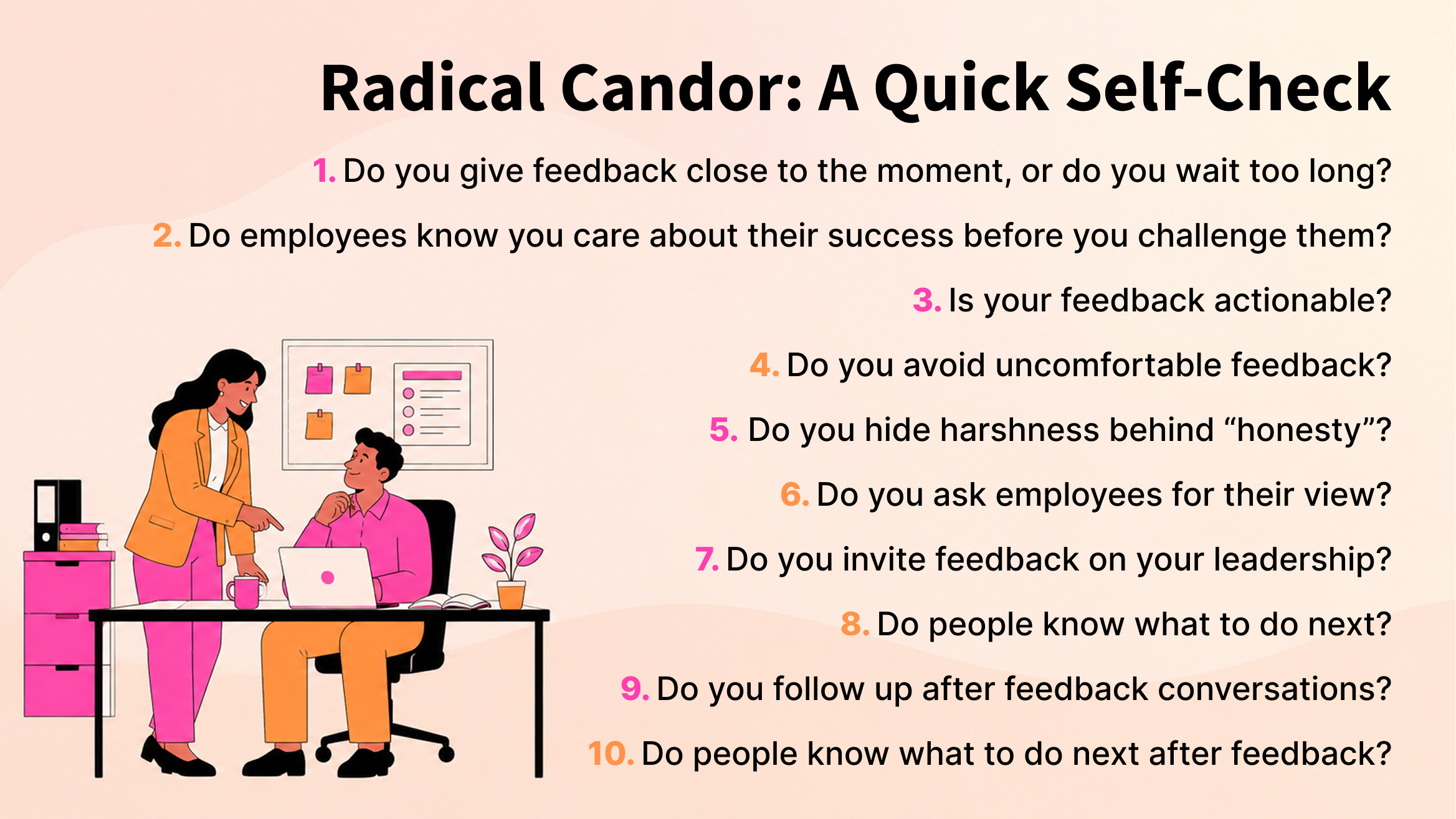
1. Build the Relationship Before the Feedback Moment
Radical Candor works best when feedback is not the only time you show care.
If the only time an employee gets your full attention is when something is wrong, your feedback will feel heavier than it needs to. They may hear every comment as criticism instead of coaching.
Build the relationship through regular one-on-ones, check-ins, clear expectations, and genuine interest in their work.
Ask questions like:
- “What are you working through right now?”
- “Where do you need support?”
- “What part of your role feels unclear?”
- “What kind of feedback is most helpful to you?”
- “What goals are you working toward?”
This does not mean you need to become best friends.
It means people should know you are invested in their success before you challenge them.
2. Give Feedback Close to the Moment
Feedback loses value when you wait too long.
If an employee made a mistake three weeks ago, they may barely remember the details. If a team member handled a situation well and you wait until the next formal review to mention it, you miss the chance to reinforce the behavior.
Informal feedback allows leaders to correct mistakes quickly and help employees learn a better way to work.
That is exactly where Radical Candor can be useful.
You don’t need to turn every comment into a formal meeting. Sometimes a short, timely conversation is better.
For example:
- “Can I give you quick feedback on that client call?”
- “There’s one thing from the meeting I want to flag while it’s fresh.”
- “You handled that question well. Here’s what worked.”
- “Let’s pause for a minute. I want to talk about how that message may land.”
Small feedback, given early, can prevent big conversations later.
3. Be Specific About the Behaviour
Vague feedback creates confusion.
If you say, “You need to communicate better,” the person may not know what to change. If you say, “In the last two project updates, the timeline changed but the team was not told until the day before,” the person has something concrete to work with.
That is why behaviour matters.
Use facts, examples, and impact.
A simple structure is:
- What happened
- Why it matters
- What needs to change
- What support or next step is needed
SEEN feedback model uses a similar approach: Situation, Evidence, Effect, and Next Steps. It helps leaders plan feedback based on what they actually saw or heard, rather than assumptions.
That keeps the conversation fair.
And fair feedback is easier to accept.
4. Balance Praise and Criticism
Radical Candor is not only for corrective feedback.
Leaders also need to give specific praise. Not generic praise. Useful praise.
Instead of saying, “Great job,” explain what made the work strong.
For example:
- “Your summary at the end of the meeting helped the client understand the next steps.”
- “You stayed calm when the conversation got tense, and that helped the team reset.”
- “The way you organized the report made the key recommendation easy to follow.”
- “You asked a strong question that helped us catch a risk before we moved forward.”
Specific praise helps people repeat what works.
It also builds trust with employees, because employees see that you are paying attention to more than mistakes.
5. Ask Permission, But Don’t Hide From the Message
Some leaders like to ask, “Can I give you feedback?”
That can be a useful way to create a moment of attention. But be careful not to use permission as an escape route.
If you are the leader and the feedback matters, you still need to give it.
You might say:
- “I have feedback that will help with the next client meeting. Is now a good time?”
- “I want to talk through something I noticed in today’s meeting.”
- “There’s a performance issue we need to address.”
- “I’d like to share one thing that went well and one thing to adjust.”
This gives the person a chance to prepare without making the feedback optional.
Kind does not mean unclear.
6. Check Your Intent Before You Speak
Before giving feedback, ask yourself one question:
“Am I trying to help, or am I trying to unload?”
That question matters.
If you are frustrated, tired, or embarrassed by the employee’s mistake, you may be more likely to speak in a way that feels sharp. The feedback may be valid, but the delivery can still damage trust.
Pause long enough to get clear.
Ask yourself:
- What is the real issue?
- What do I want the person to understand?
- What outcome do I want?
- What part of this is my frustration?
- What support does this person need?
- How can I say this directly and respectfully?
You don’t need a perfect script. You do need a clear purpose.
7. Make Feedback a Two-Way Conversation
Radical Candor should not feel like a leader talking at an employee.
After you share the feedback, make room for the other person’s view. They may have context you do not know. They may need help. They may disagree with part of your read.
Ask:
- “How do you see it?”
- “What was happening from your side?”
- “What do you think got in the way?”
- “What support would help?”
- “What would you do differently next time?”
- “What feedback do you have for me?”
This does not mean you give up your message.
It means you stay curious enough to understand the full picture.
The types of listening can help leaders think about the different ways they need to listen, especially when feedback conversations become emotional or complex.
8. Invite Feedback About Your Own Leadership
If you want your team to receive feedback well, you need to model it.
Ask for feedback on your leadership. Then respond in a way that makes people willing to do it again.
You can ask:
- “What is one thing I could do to support you better?”
- “Where am I creating confusion?”
- “What should I start, stop, or continue doing as your leader?”
- “What is one thing I may not be seeing?”
- “Where could I communicate more clearly?”
Then listen without arguing.
If you defend yourself every time someone gives you feedback, people will stop being honest.
That is how leaders accidentally train teams to stay quiet.
Common Radical Candor Mistakes To Avoid
Like any leadership tool, Radical Candor can be misused.
Here are a few mistakes to watch for.
1. Using Radical Candor as an Excuse To Be Harsh
If your feedback leaves people feeling humiliated, dismissed, or attacked, it is not Radical Candor.
It may be direct. But direct is not enough.
You need care, respect, and a clear path forward.
2. Caring So Much That You Avoid the Truth
Some leaders think they are protecting employees by softening feedback.
But if the employee does not understand the issue, they cannot fix it.
That is not fair to them or the team.
3. Waiting Too Long
When feedback is delayed, it often becomes heavier.
A quick coaching moment can become a serious performance conversation if you avoid it for too long.
Don’t wait for the perfect time. Choose a respectful time and be clear.
4. Giving Feedback Only When Something Is Wrong
If you only give corrective feedback, employees may start to tense up every time you ask to talk.
Balance it with specific, honest praise.
People need to know what to keep doing, not only what to change.
5. Making the Feedback About Personality
Focus on behavior, not character.
For example, instead of “You’re careless,” say, “The last two reports had missing numbers in the final section.” Or, instead of “You’re rude,” say, “You interrupted twice while Maya was explaining her concern.”
Behavior can be changed. Labels usually make people defensive.
6. Forgetting To Follow Up
A feedback conversation is not complete just because you said the words. You need to follow up.
Ask what changed, what support is needed, and whether the next step is clear. This shows the person that your feedback was not just criticism. It was part of their growth.
Next Steps
Radical Candor helps leaders give feedback that is clear enough to improve performance and caring enough to protect trust. It is not brutal honesty, and it is not vague kindness. It is the discipline of saying what needs to be said in a way the other person can use.
Your next step is to choose one feedback conversation you have been delaying. Write down the behavior, the impact, and the next step you want to discuss. After that, have the conversation.


 Gavin Brown


%20(1).png)
 Michelle Bennett : Nov 7, 2023, 2:14:00 PM


.png)