You finished the workday. You were in back-to-back meetings. You answered every message. You were, by all measures, busy.
And yet — nothing got done. The important stuff didn't move. And your brain feels like wet concrete.
This isn't laziness. It isn't poor time management. There's a real name for what's happening, and once you understand it, a lot of things start to make sense.
It's called cognitive load. And it might be the biggest performance problem your team has that nobody's talking about.
What is cognitive load?
Cognitive load is the amount of mental effort your brain is using at any given moment. In a work context, it refers to how much information or how many tasks your mind has to juggle simultaneously.
Imagine you're a developer fixing a tricky bug. You're focused. Then three things happen at once — your manager messages you, a meeting reminder pops up, and a colleague stops by to chat.
Now your brain has to handle all of that and get back to the bug. That's hard. You lose your place. You make mistakes. You feel drained.
That's cognitive load. Too much coming at you at once, and your brain starts to struggle.
High cognitive load causes real problems. People make more mistakes, work slower, feel worn out by the end of the day.
That's why messy processes, constant interruptions, and too much information are so bad for getting things done.
Your Brain Has a Storage Limit
Here's something most people don't know: your working memory — the part of your brain you use to think through problems, make decisions, and learn new things — can only hold about four items at once.
Four.
Not ten. Not twenty. Four.
In a landmark study, psychologist Nelson Cowan analyzed decades of memory research and found that the real limit of working memory is closer to three to five chunks of information. You can read it as The Magical Number 4 in Short-Term Memory (Cowan, 2001).
This isn't a personal failing. It's just how human brains work. The problem is that most modern workplaces are designed as if this limit doesn't exist.
Think of it like a computer. You have a certain amount of RAM. When too many tabs are open, the whole system slows down. You're not running a bad computer — you're running too many programs at once.
Cognitive load is exactly that. And when a team is overloaded, the effects show up everywhere.
Not All Mental Effort Is the Same
This is where it gets useful. In his Cognitive Load Theory (CLT), Psychologist John Sweller identified 3 types of cognitive load, and understanding the difference between them changes how you think about workload entirely.
The hard stuff (intrinsic load) — this is the actual complexity of the task. Learning a new skill, solving a difficult problem, understanding a new system. Some things are just genuinely hard. You can't eliminate this. But you can manage it.
The pointless stuff (extraneous load) — this is mental effort caused by how work is set up, not the work itself. Confusing documentation. Unclear priorities. Five different places to look for the same information. Meetings that could have been an email. This type of load adds no value whatsoever. And it's usually fixable.
The good stuff (germane load) — this is the mental energy your brain uses to actually learn something, build a skill, or create something new. This is what you want your team spending their mental energy on.
The problem is that most workplaces unknowingly drown teams in extraneous load leaving almost nothing left for the work that actually matters.
What Overload Looks Like in Practice
You might not hear anyone say "I'm experiencing high cognitive load." But you'll see the signs if you know where to look.
Work slows down. Not because people are working less, but because so much energy goes into navigating work — hunting for context, figuring out who owns what, re-reading unclear briefs — that there's little left for actual execution.
Mistakes go up. When your brain is stretched, shortcuts happen. Details get missed or quality slips. And in some fields like healthcare, engineering, aviation, these slips can be catastrophic.
Nobody's innovating. Creative problem-solving needs mental space. If your team is stuck in survival mode, putting out fires all day, new ideas simply don't have room to form. The good load gets crowded out by the pointless load.
Everyone's "busy" but nothing moves. This is the most telltale sign. A team that runs fast but covers little ground is usually one where too much energy is being spent on the mechanics of work rather than the work itself.
The Connection Between Burnout and Cognitive Load
Chronic cognitive overload isn't just a productivity issue but a health issue. When your brain is stuck in constant overload, your body's stress response kicks in — cortisol, adrenaline, the whole fight-or-flight system. It was designed for short bursts, not eight-hour workdays, five days a week.
Over time, that sustained stress turns into burnout. Burnout is emotional exhaustion, detachment, a loss of motivation for work that used to feel meaningful.
Research shows a 76% correlation between high cognitive load and burnout. That number should be alarming to any leader who cares about their team. The reason is that burnout rarely announces itself, t shows up first as poor performance.
The warning signs of burnout are easy to miss because they creep up slowly: unusual irritability, small memory slips, taking longer to do tasks that used to feel easy, a team that seems present but not quite there. These aren't character flaws. They're symptoms.
Why Organizations Create This Problem Without Realizing It
Most cognitive overload is caused by systems that weren't designed with human limits in mind.
When a company is small, information travels fast. Everyone knows what's happening. Decisions get made informally over lunch. But as the company grows, that informal system quietly breaks down — and nobody replaces it with anything better.
More roles. More tools. More meetings. More places to check for updates. More teams to coordinate with. Each of these adds a small tax on mental energy and they compound over time.
There's also the psychological safety factor, which is often overlooked. In workplaces where it isn't safe to say "I don't understand this" or "I'm overwhelmed," people quietly perform a constant mental calculation: is it safe to ask? What will people think? Will this make me look incompetent? Those tiny calculations burn mental energy that should be going toward actual work.
5 Ways Leaders Can Reduce Their Team's Cognitive Load
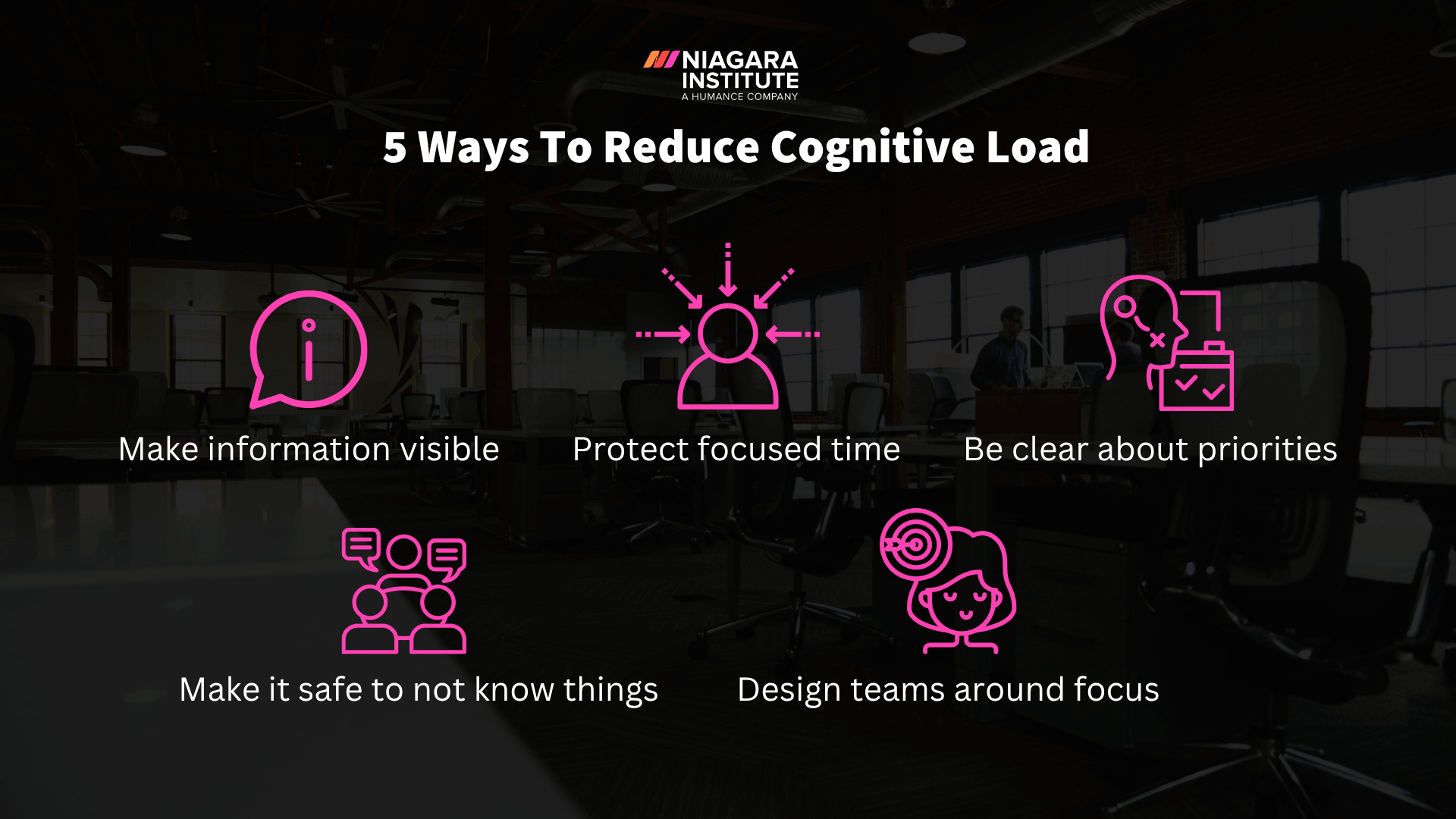
1. Make information visible, not memorable. Stop relying on people to keep things in their heads. Project boards, shared dashboards, clear documentation — these aren't just organizational tools. They're cognitive offloading devices. Information that lives outside someone's head doesn't take up space inside it.
2. Protect focused time. Slack pings, email notifications, quick questions — each interruption doesn't just take a few seconds. It takes your brain roughly 20 minutes to return to a state of deep focus after being pulled out of it. Build real quiet-time blocks into the week. Protect them like you'd protect an important meeting.
3. Be relentlessly clear about priorities. Ambiguity is expensive. When someone doesn't know what "done" looks like, or which of five tasks is most important today, they carry that uncertainty around all day. It sits in their working memory, crowding out everything else. Clear priorities are helpful and cognitively generous.
4. Make it safe to not know things. This one requires real culture work. But when people can say "I don't know" or "I'm struggling" without it costing them something socially, they stop spending energy managing how they appear. That energy gets redirected to actually solving problems.
5. Design teams around focus, not flexibility. The instinct to pull people across multiple projects feels efficient. It usually isn't. Every time someone switches context — from one project, one team, one tool to another — there's a cognitive cost. Small, stable teams with a clear domain build expertise over time and spend far less mental energy just getting oriented.
The Shift Worth Making
The "hustle culture" version of productivity says that if things aren't moving fast enough, the answer is more effort. More hours. More urgency.
But for most teams, the problem is friction. It's all the invisible work that sits on top of the real work — the confusion, the noise, the ambiguity, the context-switching — eating up the mental energy that should go toward the actual job.
Reducing cognitive load is what it actually means to work smarter, not harder. Simpler to navigate. Less expensive to think about.
When you get that right, something shifts. Work starts moving again. Errors drop. People have energy for actual ideas. The team stops being busy and starts being productive.
That's not a soft benefit. That's the whole point.

 Gavin Brown




 Gavin Brown : Jul 26, 2026, 5:36:19 AM