

 Gavin Brown
.jpg)
You lead leaders now. That means you are further removed from the people doing the actual work. You mostly hear about them through their managers. By the time an update reaches you, it has already been filtered. And people rarely pass along the bad news.
That's exactly the problem skip-level meetings were built to solve. Done well, they give you unfiltered insight, build trust across levels, and surface small problems before they become big ones. Done poorly, they feel like an audit — for everyone involved.
Fortunately, the difference comes down to preparation. In this article, you'll find what a skip-level meeting is, how to run one in seven steps, a ready-to-use 45-minute agenda, and the most common mistakes to avoid. Let's jump in.
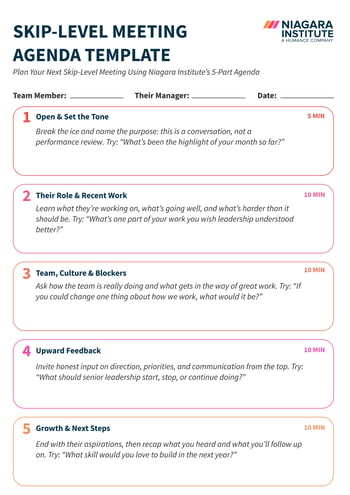
Free Download: Want to walk into your first skip-level with a plan? Grab Niagara Institute's Skip-Level Meeting Agenda Template — a printable one-pager with five timed sections and go-to questions for each.
What Is a Skip-Level Meeting?
A skip-level meeting is a conversation between a senior leader and an employee who reports to one of their direct reports. It skips one level of the organization. These meetings are usually one-on-one and last 30 to 60 minutes. They typically happen once every few months or twice a year.
Just as important is what a skip-level meeting is not: a performance review, an investigation, or a way to go around the manager in the middle. It's a listening session. You're there to understand what's really happening on the front lines — and to show the people two levels down that they're seen.
Why Skip-Level Meetings Are Worth Your Time
Think about how information travels up an org chart. By the time an update reaches you, it has been summarized, softened, and shaped by at least one other person's priorities. That's not deception; it's human nature. But it leaves you making decisions with an incomplete picture.
Skip-levels close that gap. They also do something powerful for your people: they signal that their voice matters. According to Salesforce Research, employees who feel their voice is heard are 4.6 times more likely to feel empowered to perform their best work.
These conversations also help you build a stronger team. You can spot rising talent, recurring problems, and coaching opportunities for your direct reports. You can learn all this in less than an hour.
How to Run a Skip-Level Meeting in 7 Steps
1. Loop in the manager first
Always tell the manager about the skip-level meeting beforehand. Explain what you are doing, why you are doing it, and when it will happen. Make it clear that this is a regular practice, not a sign that there is a problem. Tell them you plan to meet with everyone on a rotation. When managers understand the purpose, they are less likely to feel watched. They can also see the benefit of having another leader help their team solve problems.
2. Send an invite that lowers the temperature
An unexpected meeting with a senior leader can make people nervous. So explain the purpose in the invite. Tell them it is a casual conversation about how things are going. Let them know they do not need to prepare. You can also share two or three questions you plan to ask. This gives people time to think and helps them feel more comfortable.
3. Prepare, but hold the agenda loosely
Come with a simple structure. Have an opening question, a few topics to discuss, and a closing question. Then let the conversation flow naturally. If the person brings up a process problem or a career goal, explore it with them. The agenda should guide the conversation, not control it. The template at the end of this article can help you prepare.
4. Open by naming the elephant
Start by making the purpose clear. Say, "This isn't a performance review, and nothing you share will be quoted back to anyone. I'm here to learn." Then keep the first few minutes casual. Ask about their month, a recent win, or what they enjoy most about their work. Small talk can help build trust and make the conversation more comfortable.
5. Ask, then actually listen
Try to talk 20% of the time and listen for the other 80%. Ask open-ended questions and give people time to answer. Use follow-up questions like "Tell me more about that" or "What would you change?" Avoid explaining, defending, or trying to fix things right away. If you argue with someone's experience, they may stop sharing.
6. Handle what you hear with care
Do not promise complete confidentiality. You may hear something that you need to act on. Instead, promise discretion. Tell them you will share general themes, not names, and you will not quote them to their manager. If they raise a concern about their manager, listen without taking sides. Take the concern seriously and decide what to do after the meeting.
7. Close the loop afterward
End the meeting by summarizing what you heard and explaining what you will do next. If you need time to think, say so. Then follow through and let them know what happened. When people see that their feedback leads to action, they are more likely to speak openly in the future.
The 45-Minute Skip-Level Meeting Agenda
If you don't want to build your agenda from scratch, use this five-part structure. It is the same structure included in the free template:
- Open and set the tone (5 minutes): Break the ice and restate the purpose out loud. Try: "What's been the highlight of your month so far?"
- Their role and recent work (10 minutes): Learn what they're working on, what's going well, and what's harder than it should be. Try: "What's one part of your work you wish leadership understood better?"
- Team, culture, and blockers (10 minutes): Ask how the team is really doing and what gets in the way of great work. Try: "If you could change one thing about how we work, what would it be?"
- Upward feedback (10 minutes): Invite honest input on direction, priorities, and communication from the top. Try: "What should senior leadership start, stop, or continue doing?"
- Growth and next steps (10 minutes): End with their aspirations, then recap what you heard and what you'll follow up on. Try: "What skill would you love to build in the next year?"
4 Skip-Level Mistakes to Avoid
Even well-intentioned leaders can fall into a few common traps. Here are four mistakes to avoid:
- Turning it into a status update: If you spend the meeting talking about projects, you miss the point. You can get project updates from a dashboard. You need conversations to understand what your team is experiencing.
- Grilling them about their manager: Asking for negative information about their manager puts the employee in a difficult position. It can also hurt your working relationship with the manager. Focus on the work and the team. If they have feedback about their manager, let them bring it up naturally.
- Doing all the talking: Some leaders fill every silence by talking about their plans and vision. Resist that urge. Give the other person time to think and speak. You are there to listen.
- Letting it be a one-off: One skip-level can feel like an inspection. Regular meetings show that listening is part of how you lead. Schedule the next meeting before the current one ends.
If You're the One Invited to a Skip-Level
If you are the person being invited, there is no need to worry. Skip-level meetings are normal and are usually a good sign. Here are a few ways to make the most of the conversation:
-
Come with 2-3 talking points. Think of one thing that is going well, one thing that could work better, and one question you want to ask.
-
Be honest and constructive. Focus on the work, processes, and priorities instead of personalities. You can be honest without making it personal.
-
Ask questions too. A skip-level gives you a chance to understand how the organization thinks and where it is going. Take advantage of that opportunity.
If You're the Manager Being Skipped
It can feel uncomfortable when your leader meets with your team without you. Try not to take it personally. Skip-levels are about building connections across the organization. They are not a sign that your leader doubts you.
- Don't take it personally. A skip-level helps your leader understand your team better. Strong leaders see it as a normal part of good management.
- Never coach your team on what to say. It can make people feel pressured and can damage trust. Let them speak openly about their experience.
- Ask for themes afterward. What your leader hears can give you useful insight into your team. Treat it as an opportunity to understand what is working and what could improve.
Next Steps
Skip-level meetings are simple, but they need to be intentional. Let the manager know first, make the conversation comfortable, listen more than you talk, and always follow up. When you do this consistently, problems reach you sooner, trust grows, and you get a clearer view of what is happening across your team.
You do not need to wait for the perfect moment. Pick two people and send them a calendar invite. Then download the free Skip-Level Meeting Agenda Template to help you prepare. In just 45 minutes, you can hear what the org chart does not show you.