You walk into a meeting and already know how it will go. One group will back each other up. Another group will stay quiet. A few people will leave feeling like the decision was made before they even sat down.
That’s often how tribalism in the workplace shows up. Not as one big dramatic event, but as small patterns that make people feel included, excluded, protected, or ignored.
Left alone, workplace tribalism can damage trust, slow down decision-making, and turn normal differences into “us versus them” thinking. The hard part is that it can look like loyalty, friendship, or team pride at first.
So, how do you spot the difference?
What Is Tribalism in the Workplace?
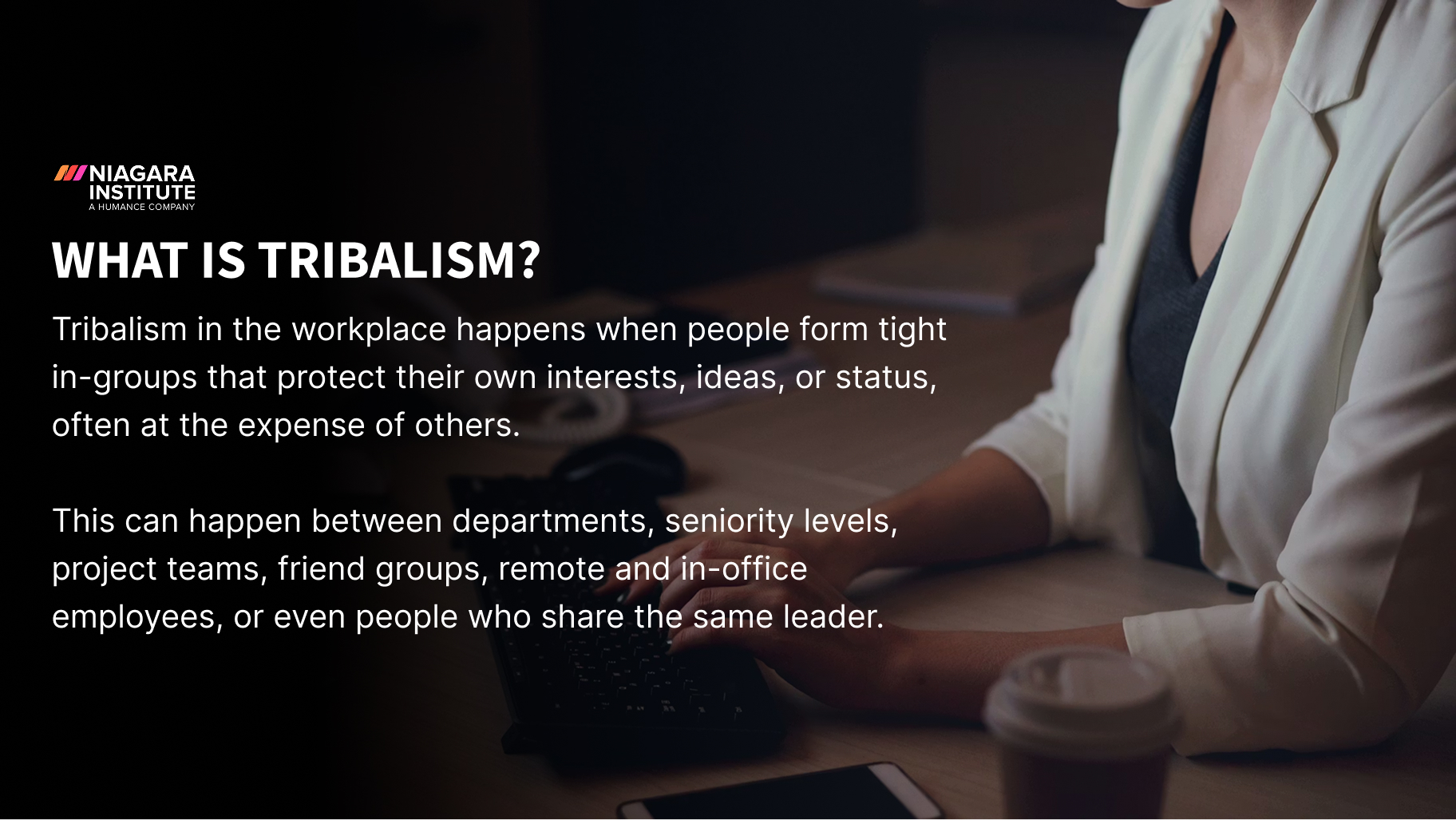
Tribalism in the workplace happens when people form tight in-groups that protect their own interests, ideas, or status, often at the expense of others.
This can happen between departments, seniority levels, project teams, friend groups, remote and in-office employees, or even people who share the same leader. The “tribe” becomes the group people trust, defend, and listen to first.
To be clear, close working relationships are not the problem. Strong teams need trust, shared identity, and a sense of belonging.
The problem starts when belonging to one group means shutting out another.
In other words, the group becomes more important than the work.
Workplace tribalism is closely connected to in-group favoritism. Research on in-group favoritism has shown that people can favor those they see as part of their own group, even when the group itself is fairly arbitrary. In a workplace, that can turn into biased actions and decisions, selective communication, and uneven access to opportunities.
It may not always be intentional. But it still has an impact.
Why Tribalism Happens at Work
Most people don’t wake up and decide to create division at work. Tribalism often grows because people are looking for safety, clarity, or influence.
When work feels uncertain, people naturally look for “their people.” They want someone who understands the pressure, shares the same frustrations, and will have their back when things get hard.
That’s human.
But when leaders don’t pay attention, those informal groups can start shaping the culture more than the company values do.
Here are a few common reasons tribalism takes root at work.
People Want Belonging
Everyone wants to feel accepted at work. When employees don’t feel connected to the larger team or organization, they may form smaller groups where they feel seen and understood.
This is not always negative. The trouble starts when belonging in one group depends on criticizing, avoiding, or competing with another group.
Leaders Accidentally Reward It
Sometimes tribalism grows because leaders give more time, information, flexibility, or opportunity to certain people.
This may look a lot like the warning signs listed in Niagara Institute’s article on signs of favoritism at work. When one group gets more access than another, people notice.
And they rarely forget it.
Conflict Goes Unaddressed
Unresolved conflict is fuel for workplace tribalism. If two teams disagree and no one helps them work through it, people will often retreat to their own side.
That’s when the story changes from “we disagree on the best approach” to “they never support us.”
If this sounds familiar, Niagara Institute’s guide to conflict resolution techniques is a helpful place to start.
Information Is Not Shared Equally
When some people hear updates first and others hear them late, tribalism gets stronger. It creates a sense that there are insiders and outsiders.
Even if the leader didn’t mean to create that divide, the message employees receive is clear: some people are closer to power than others.
That is how trust erodes.
The Culture Tolerates Cliques
Cliques don’t always look harmful from the outside. They may look like lunch groups, inside jokes, private chats, or people who always agree with one another in meetings.
But over time, cliques can make others feel like they need permission to speak, challenge, or belong.
That’s not a small issue. That’s a culture issue.
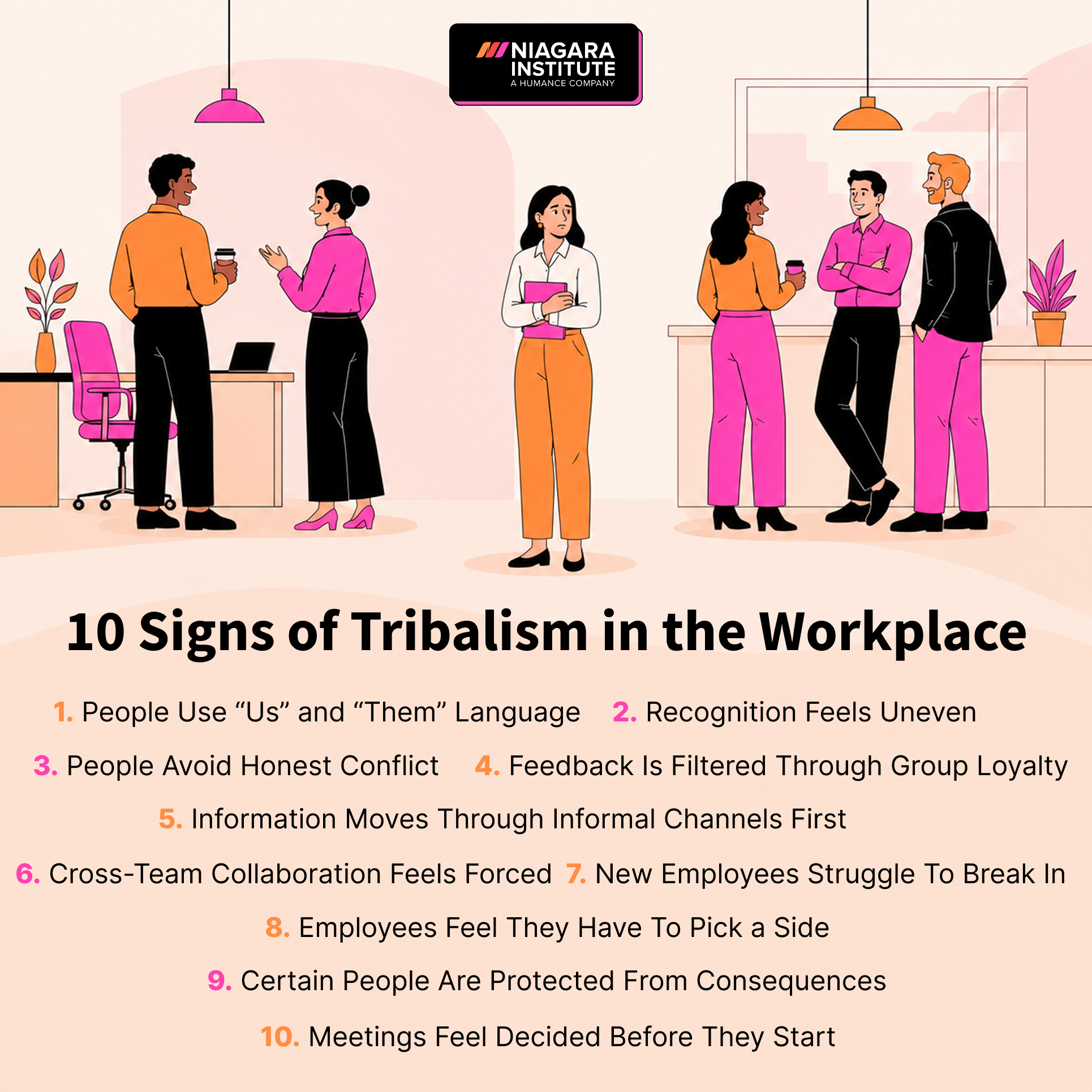
10 Signs of Tribalism in the Workplace
Workplace tribalism is not always obvious. You may need to look for repeated patterns rather than one-off moments.
Here are 10 signs to watch for.
1. People Use “Us” and “Them” Language
Pay attention to how people talk about other teams or groups.
You might hear things like:
- “They don’t understand what we do.”
- “That team always makes things harder.”
- “We’re the only ones who actually care.”
- “They get away with everything.”
A little frustration is normal. But when “they” becomes the default way to describe colleagues, you may have a tribalism problem.
Language reveals the line people have drawn.
2. Information Moves Through Informal Channels First
In a healthy workplace, key information is shared clearly and fairly.
In a tribal workplace, information moves through favourites, friends, or private groups before it reaches everyone else. Some people know about decisions, changes, or opportunities early. Others find out when it’s too late to contribute.
This creates a quiet power structure.
The people “in the know” gain influence. Everyone else has to catch up.
3. Meetings Feel Decided Before They Start
One of the clearest signs of tribalism in the workplace is when meetings become a performance rather than a discussion.
People may nod along because they know challenging the dominant group will go nowhere. Others may avoid speaking because they assume their input won’t be taken seriously.
You might also notice the same people backing each other up, even when the idea is weak.
That’s not collaboration. That’s alignment without examination.
4. Certain People Are Protected From Consequences
In tribal workplaces, mistakes at work are not treated equally.
One person misses a deadline and gets understanding. Another person misses a deadline and gets criticism. One group gets the benefit of the doubt. Another group has to prove itself again and again.
This is where tribalism and favouritism often overlap.
A 2022 study published in Frontiers in Psychology looked at nepotism, favouritism, and organisational climate. The researchers surveyed 269 workers and found that organisational climate is influenced by factors such as manager behaviour, communication, relationships, values, and safety.
That makes sense. When people see unfair protection, they stop trusting the system.
5. Cross-Team Collaboration Feels Forced
Collaboration should not feel like pulling teeth.
If teams only work together when a senior leader forces them to, there may be deeper division underneath the surface. People may withhold information, delay responses, question motives, or do the bare minimum to support another group.
This is especially common when teams compete for budget, recognition, headcount, or executive attention.
The work becomes secondary to winning.
6. Employees Feel They Have To Pick a Side
This is one of the more damaging signs.
When tribalism is strong, employees may feel pressure to align with a person, group, department, or opinion. Staying neutral can feel risky. Asking fair questions can be seen as disloyal.
That puts employees in a tough position.
Instead of focusing on the best decision, they focus on staying safe.
7. New Employees Struggle To Break In
New employees can often spot tribalism faster than long-time employees. They notice who gets included, who gets ignored, and which relationships seem to matter most.
If new hires are left to figure out the hidden rules on their own, they may feel like outsiders from the start.
That can hurt confidence, connection, and retention.
It can also lead them to join a tribe quickly, just so they don’t feel alone.
8. Feedback Is Filtered Through Group Loyalty
In healthy teams, feedback is about improving the work.
In tribal teams, feedback can become personal. People defend their group instead of listening. They dismiss feedback from outsiders. They accept the same feedback more easily when it comes from someone “on their side.”
This is why listening matters so much.
Niagara Institute’s article on the types of listening is a useful reminder that leaders need more than one listening skill. At times, you need to listen for facts. At other times, you need to listen for emotion, meaning, or what is not being said.
9. Recognition Feels Uneven
Recognition sends a message about what and who matters.
When leaders keep praising the same group, assigning the same people visible work, or celebrating one team more than others, employees notice.
They may not say anything right away. But they will adjust their level of trust.
Uneven recognition can make people feel invisible, even when they are doing good work.
10. People Avoid Honest Conflict
On the surface, tribalism may look calm. People are polite. Meetings are controlled. No one openly argues.
But underneath that calm, people may be avoiding the real conversation.
Niagara Institute’s workplace conflict research found that over 700 respondents from 36 countries had different natural approaches to conflict. In another Niagara Institute communication survey, 54% of respondents said they talk through conflict with peers to find a win-win solution, while 59.8% use a collaborating style to resolve workplace conflict.
That’s encouraging.
But in tribal workplaces, collaboration can get replaced by avoidance, gossip, or side conversations. The conflict doesn’t disappear. It just moves underground.
Why Workplace Tribalism Is a Leadership Problem
It’s easy to think of tribalism as an employee behaviour problem. After all, employees may be the ones forming cliques, gossiping, or resisting other teams.
But leaders shape the conditions where tribalism either grows or weakens.
If you are in a leadership role, your decisions tell people what is acceptable. Who you listen to, who you promote, who you forgive, who you challenge, and who you include all send signals.
People are watching for fairness.
When leaders ignore tribalism, it can lead to:
- Lower trust in leadership
- More conflict between teams
- Poor communication
- Slower decisions
- Less honest feedback
- Lower morale
- Stronger favouritism concerns
- A more toxic work environment
If you’re wondering whether the issue has become bigger than team tension, Niagara Institute’s article on spotting a toxic work environment may help you compare the patterns.
Tribalism is not always loud. But it is costly.
How To Address Tribalism in the Workplace
You don’t fix tribalism with one team-building activity. You fix it by changing the patterns that allow it to keep happening.
Here are practical places to start.
1. Name the Pattern Without Attacking People
Start by describing what you are seeing, not by labelling people.
Instead of saying, “This team is acting tribal,” try:
- “I’m noticing that information is not reaching everyone at the same time.”
- “I’m hearing more ‘us and them’ language between our teams.”
- “I’m seeing the same voices shape decisions before others have input.”
- “I’m concerned that some people may feel outside the circle.”
This keeps the conversation focused on behaviour.
That matters because people can change behaviour. They will usually defend their identity.
2. Look at Your Own Leadership Habits First
Before you address tribalism with others, look at your own actions.
Ask yourself:
- Who do I go to first for input?
- Who gets the most context from me?
- Who do I give the benefit of the doubt to?
- Who receives stretch assignments?
- Who gets more informal access to my time?
- Whose mistakes do I explain away?
- Whose ideas do I question more closely?
This is not about blaming yourself for everything. It’s about checking whether your habits are feeding the pattern.
Sometimes the leader is the centre of the tribe and doesn’t know it.
3. Make Access to Information More Fair
If information is power, then leaders need to be careful with how it moves.
Create simple habits that reduce insider-outsider dynamics and improves poor communication:
- Share key updates in team channels, not only in private conversations
- Recap decisions after meetings
- Make project context available to everyone who needs it
- Clarify who was consulted and why
- Avoid giving select people early access unless there is a clear reason
This may sound basic. But basic things often repair trust.
4. Set Clear Decision-Making Rules
Tribalism grows when people believe decisions are based on relationships more than criteria.
So make the criteria visible.
For example, clarify:
- Who owns the decision
- Who gives input
- What information will be considered
- What trade-offs matter most
- How the final decision will be shared
- How concerns can be raised
This helps people see that decisions are not being made by the loudest group, closest group, or most favoured group.
Clarity reduces suspicion.
5. Create More Cross-Group Work
If people only work with their own group, their assumptions about others rarely get challenged.
Look for practical ways to mix groups around meaningful work, not forced bonding.
You could:
- Pair employees from different teams on a project
- Rotate meeting leads
- Create cross-functional problem-solving groups
- Invite quieter voices into planning conversations
- Ask teams to present shared wins together
- Build peer learning groups across departments
The goal is not to make everyone best friends. The goal is to help people understand each other’s work, constraints, and value.
6. Address Favouritism Concerns Directly
If tribalism is tied to favouritism, you need to take it seriously.
Employees may not use the word “favouritism.” They may say things like:
- “It depends who asks.”
- “The rules are different for them.”
- “There’s no point speaking up.”
- “They already know who they want.”
- “Some people can do whatever they want.”
Don’t dismiss comments like these as complaining. They may be pointing to a real fairness issue.
This is where leadership training can help. Programs such as Niagara Institute’s Supervisor Training cover core skills like communication, listening, team management, relationship building, and setting expectations, all of which matter when leaders are trying to build a fairer team culture.
7. Build Better Feedback Habits
Feedback can either reduce tribalism or make it worse.
If feedback is vague, delayed, or only given to certain people, it can feed distrust. If feedback is clear, consistent, and fair, it helps people understand where they stand.
As a leader, make sure you are not coaching only the people you naturally like or relate to.
Everyone on your team deserves useful feedback.
Niagara Institute’s Leader as Coach program is built around helping leaders give practical, useful feedback and coach employees in a way that supports performance, trust, and accountability.
8. Use a Culture Survey To Surface the Truth
Sometimes employees won’t tell you about tribalism directly. They may worry about being seen as negative, dramatic, or disloyal.
A simple culture survey can help you spot patterns in a safer way.
You might ask:
- Do you feel included in team decisions that affect your work?
- Do you believe opportunities are shared fairly?
- Do you feel comfortable raising a different point of view?
- Do you trust that leaders apply expectations consistently?
- Do you feel respected by people outside your immediate team?
- Where do you see “us versus them” thinking on our team?
- What would help this team work more as one group?
The point is not to collect feedback and move on. The point is to act on what you learn.
9. Hold People Accountable for Divisive Behaviour
You can be warm and still be direct.
If someone constantly undermines another team, withholds information, excludes others, or turns disagreements into personal loyalty tests, address it.
You might say:
- “I want to pause on the ‘they always’ language. What specifically happened?”
- “We need to bring this concern to the group involved, not discuss it only here.”
- “I’m not comfortable with decisions being shaped before everyone has input.”
- “It’s fair to disagree. It’s not fair to question their motives without evidence.”
- “I need you to work with them directly on this, not around them.”
This is the leader’s job.
You don’t need to make it dramatic. You do need to make it clear.
10. Reinforce One Shared Team Identity
The answer to workplace tribalism is not to remove all smaller group identities. Departments, project teams, and peer groups will always exist.
The key is to make sure those identities sit inside a larger shared identity.
Remind people of:
- The common goal
- The customer or stakeholder you serve
- The values you expect in day-to-day behaviour
- The standard for how teams work together
- The cost of working against each other
- The wins that only happen when groups cooperate
People need to know what they are part of together.
That’s how you shift from “my group versus your group” to “our work, our standards, our results.”
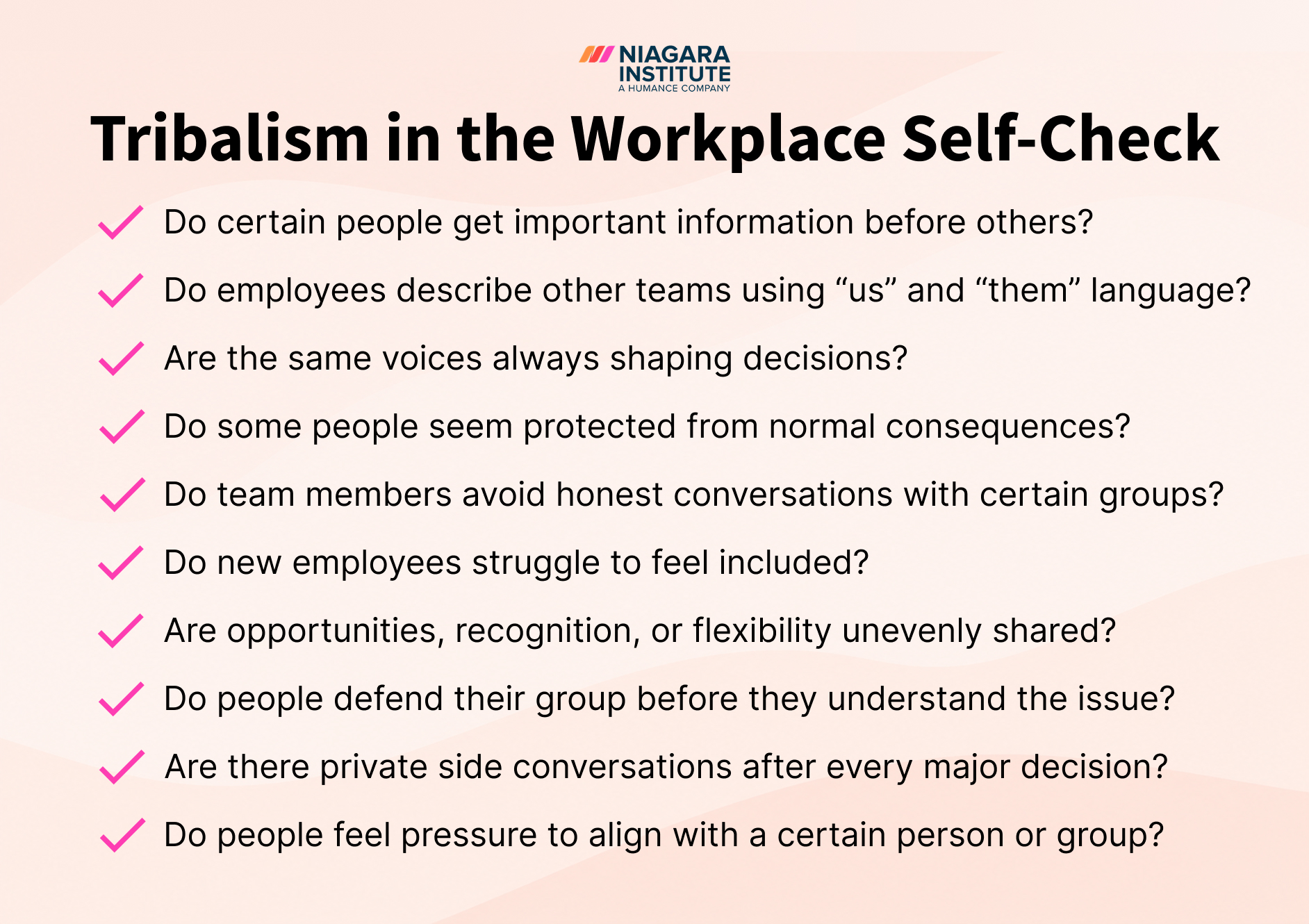
Tribalism in the Workplace: A Quick Self-Check
If you’re not sure whether tribalism is happening on your team, use the questions below as a quick starting point.
Answer honestly.
- Do certain people get important information before others?
- Do employees describe other teams using “us” and “them” language?
- Are the same voices always shaping decisions?
- Do some people seem protected from normal consequences?
- Do team members avoid honest conversations with certain groups?
- Do new employees struggle to feel included?
- Are opportunities, recognition, or flexibility unevenly shared?
- Do people defend their group before they understand the issue?
- Are there private side conversations after every major decision?
- Do people feel pressure to align with a certain person or group?
If you answered yes to several of these, it may be time to look more closely.
You don’t need to solve everything at once. Start with the pattern that is causing the most damage.
Then address it consistently.
Next Steps
Tribalism in the workplace can start small, but it rarely stays small. If you want a healthier team culture, watch for the patterns: insider information, uneven treatment, side-taking, poor collaboration, and “us versus them” language.
Your next step is to pick one pattern and address it directly. Clarify a decision, share information more fairly, ask for honest feedback, or have the conversation you’ve been avoiding.
A more connected workplace is built through steady leadership habits, not one big announcement.

 Gavin Brown



 Michelle Bennett : May 20, 2021, 5:30:00 AM
.png)
.png)